
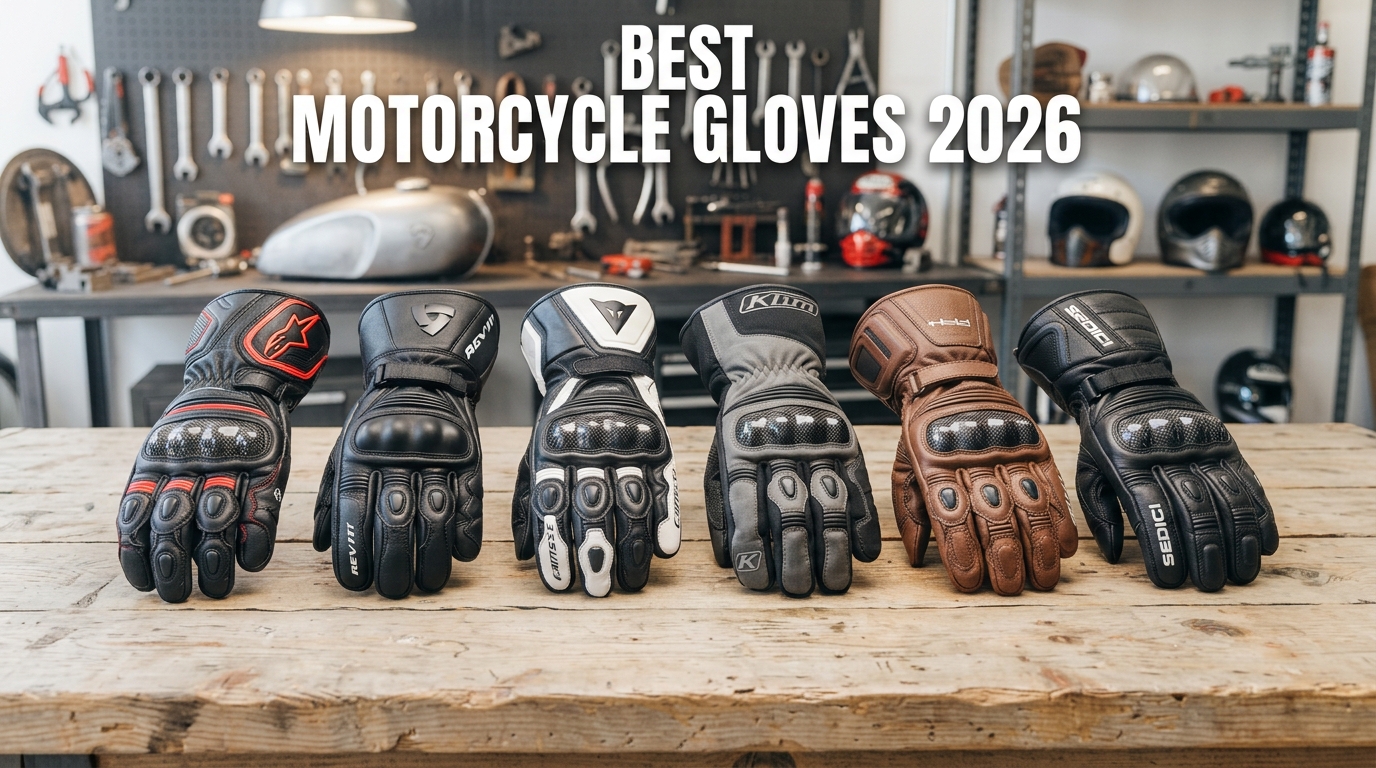
Gloves are the piece of kit most riders upgrade last and regret first. Your hands hit the ground before almost any other part of your body in a crash, and unlike a helmet, gloves are worn every single ride. Getting them right matters.
This guide covers the best motorcycle gloves available in 2026 across three price categories: budget, mid-range, and premium. Every pick is CE-certified, tested by riders, and selected for a specific type of rider – not just ranked by price.
Disclosure: Gear4Moto uses affiliate links. If you purchase through a link on this page, we may earn a small commission at no extra cost to you. This does not influence our recommendations.
What’s in this article
What to Look For in Motorcycle Gloves
Before the picks, a quick framework for choosing.
CE certification is the most important number on the label. EN 13594:2015 is the current European standard. It has two levels: Level 1 covers everyday street riding; Level 2 provides a higher level of impact protection and is found in mid-range and premium gloves. A glove with no CE certification or only the older EN 13594:2011 standard is a step behind.
Cuff length splits into two styles. Short-cuff gloves (wrist-length) are easier to put on and feel less restrictive. Full-gauntlet gloves extend up the forearm and provide more coverage over the wrist and lower arm. For sport and naked bike riders, a gauntlet is generally better protection. For scooters and commuting, a short cuff is more convenient.
Palm protection is often overlooked on the spec sheet. The palm is the most common first contact point in a crash. Look for hard armour, aramid reinforcement (such as Arshield or Superfabric), or at minimum a reinforced slider panel.
Finger bridge links the third and fourth fingers structurally. In a slide, fingers can separate at the seams – a bridge prevents that. It appears on higher-spec gloves and is worth having if it is available.
Best Motorcycle Gloves 2026 – Our Picks
Best Budget: Alpinestars SP-8 V3 (~€90–110)
CE Level 1 | Full gauntlet | Goat leather
The SP-8 V3 is the most consistently recommended sport glove under €110, and it deserves its reputation. Full-grain goat leather construction, a MotoGP-derived hard knuckle protector, and Alpinestars’ patented third-and-fourth finger bridge are all features you usually only find at higher prices. CE Level 1 certified under EN 13594:2015.
The palm uses Arshield – an aramid and polyamide blend – rather than hard armour. That is the main trade-off at this price. For street riding it is more than adequate; for track days, you would want hard palm armour. Read our full Alpinestars SP-8 V3 review for the complete picture. Do you want to now more avout the SP-8 V3? Read the full review here!
Best for: Sport and naked bike riders, beginners, everyday commuters. Score: 4.0/5
Best Mid-Range: Dainese Impeto (~€180–200)
CE Level 1 | Full gauntlet | Leather + textile
The Dainese Impeto hits the gap between entry-level sport gloves and full race kit. The one-piece palm leather minimises seam lines in the most abrasion-prone area – a meaningful construction detail that most gloves at this price do not include. Hard TPU knuckles sit over a robust leather backhand, and the double wrist closure keeps the glove secure without pressure points.
Ventilation is good for a leather gauntlet. The Impeto works well across three seasons and suits riders who want more protection than a budget glove provides without the price or stiffness of a full race glove.
Best for: Sport and sport-touring riders who want a step up from entry-level. Score: 4.2/5
Best Sport-Touring: Alpinestars GP Plus R V3 (~€200–230)
CE Level 1 | Full gauntlet | Full-grain leather
The GP Plus R V3 sits just below Alpinestars’ race range and delivers near-race protection in a glove that is comfortable enough for long touring days. The DFS dual-density knuckle guard is a step above the SP-8 V3’s protector, and the pre-curved anatomical construction works naturally in a sport-riding position without fatigue on longer rides.
Break-in time is longer than softer leather gloves – allow 500 km before judging the fit. Once broken in, the GP Plus R V3 is one of the best-fitting gloves in its category.
Best for: Sport-touring riders, riders who want near-race protection without track-only stiffness. Score: 4.3/5
Best Premium: Knox Handroid MK5 (~€320–380)
CE Level 2 | Full gauntlet | Leather + exoskeleton
The Knox Handroid MK5 is unlike anything else at this price. The exoskeleton finger spines are not decorative – they structurally link the fingers and transfer impact loads away from the joints in a way that standard finger bridges cannot match. CE Level 2 certified, which is the highest level available under EN 13594:2015.
The BOA dial closure is divisive: some riders love the single-handed micro-adjustment; others find it less secure than a traditional hook-and-loop system. Try before you buy if possible. At the price, it is a significant investment – but for riders who want the most protection available outside of a full race glove, the Handroid MK5 is the clearest choice.
Best for: Riders prioritising maximum protection; sport and naked bike riders who want Level 2 certification. Score: 4.5/5
Best Budget CE-Certified: Cortech Apex RR (~€80–100)
CE certified | Full gauntlet | Goatskin
For riders who need a solid CE-certified gauntlet under €100, the Cortech Apex RR competes directly with the SP-8 V3. Carbon fibre knuckle, heel, and finger protectors in a goatskin construction at a lower entry price. It lacks the finger bridge and the brand recognition of Alpinestars, but the protection spec is strong for the price.
If the SP-8 V3 is out of stock or above budget, the Apex RR is a credible alternative.
Best for: Budget-conscious riders who want certified protection in a full gauntlet. Score: 3.8/5
Quick Comparison
| Glove | Price | CE Level | Cuff | Palm armour | Finger bridge |
|---|---|---|---|---|---|
| Alpinestars SP-8 V3 | ~€105 | Level 1 | Gauntlet | Arshield (soft) | Yes |
| Dainese Impeto | ~€190 | Level 1 | Gauntlet | Hard TPU | No |
| Alpinestars GP Plus R V3 | ~€215 | Level 1 | Gauntlet | Soft | No |
| Knox Handroid MK5 | ~€350 | Level 2 | Gauntlet | Hard | Yes (exoskeleton) |
| Cortech Apex RR | ~€90 | CE certified | Gauntlet | Hard carbon | No |
Which Gloves Should You Choose?
New rider or commuter on a budget: Start with the Alpinestars SP-8 V3. CE Level 1, proper knuckle protection, finger bridge, and goat leather at a price that does not hurt. See our full guide to the best motorcycle gear for beginners.
Rider who wants more than the basics: The Dainese Impeto adds hard knuckle armour and a one-piece palm panel at a step up in price. A clear upgrade from entry-level.
Sport-touring rider doing longer days: The Alpinestars GP Plus R V3 balances protection and long-distance comfort better than anything else in its price band.
Maximum protection, budget is secondary: The Knox Handroid MK5. CE Level 2, exoskeleton finger protection, and a construction that genuinely differs from the field.
Frequently Asked Questions
What CE level should motorcycle gloves have?
CE Level 1 is the minimum for everyday street riding and is adequate for most riders. CE Level 2 offers higher impact protection and is found in mid-range and premium gloves. Both levels test under EN 13594:2015, which is the current European standard. Gloves without CE certification offer no independently verified level of protection.
Are expensive motorcycle gloves worth it?
For most street riders, a quality CE Level 1 glove in the €90–150 range covers all everyday riding needs. The step to Level 2 and premium materials makes a meaningful difference for riders who do track days or prioritise maximum protection. For commuting and general street riding, the Alpinestars SP-8 V3 or equivalent delivers most of what more expensive gloves offer.
Should motorcycle gloves have a long cuff?
A full gauntlet cuff provides more wrist and forearm coverage in a crash and is generally preferable for sport and naked bike riding. Short-cuff gloves are more convenient for urban commuting and scooter use where protection-to-ease-of-use is the priority. For most riders on a motorcycle rather than a scooter, a gauntlet is the better choice.
How do I know if motorcycle gloves fit correctly?
Gloves should fit snugly without restricting blood flow. Fingers should reach the fingertip without bunching. There should be no gap between the glove and your jacket cuff. Leather gloves will loosen with use – if they feel slightly tight new, that is normal. If they feel painful or restrict movement, go up a size.
Gear4Moto Verdict
The best motorcycle gloves in 2026 are the ones that match your riding – not the most expensive ones available. For most riders, the Alpinestars SP-8 V3 is the starting point: CE Level 1, goat leather, finger bridge, and a price that is easy to justify. Step up to the Dainese Impeto or Knox Handroid MK5 when your riding demands more protection or your budget allows.
Whatever you choose, make sure it is CE certified. Your hands will thank you.
Disclosure: Gear4Moto uses affiliate links. If you purchase through a link on this page, we may earn a small commission at no extra cost to you. This does not influence our recommendations.