
The question of full face vs open face helmet safety comes up constantly in motorcycle communities, gear forums, and first-time buyer guides. It sounds like a simple comparison, but the answer involves crash data, biomechanics, real-world comfort trade-offs, and a clear look at what the research actually shows.
This article gives you the complete picture. We cover what the studies say, what the data shows about where impacts actually occur in crashes, what the practical differences are between the two helmet types, and how to make the right choice for your own riding.
Disclosure: Gear4Moto uses affiliate links. If you purchase through a link on this page, we may earn a small commission at no extra cost to you. This does not influence our recommendations.
What’s in this article
What Is a Full Face Helmet?
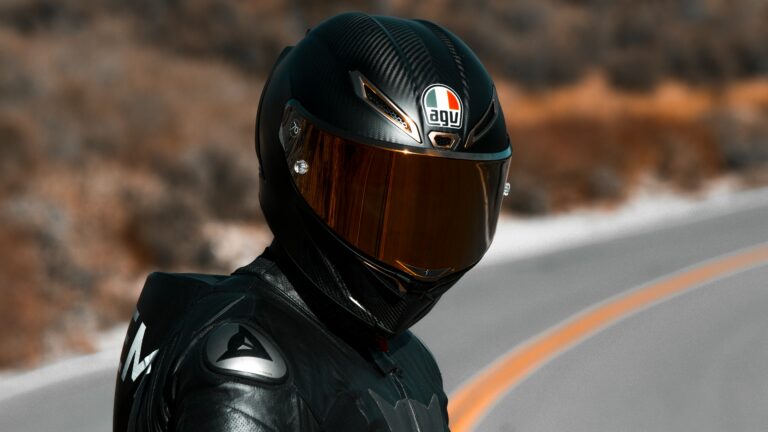
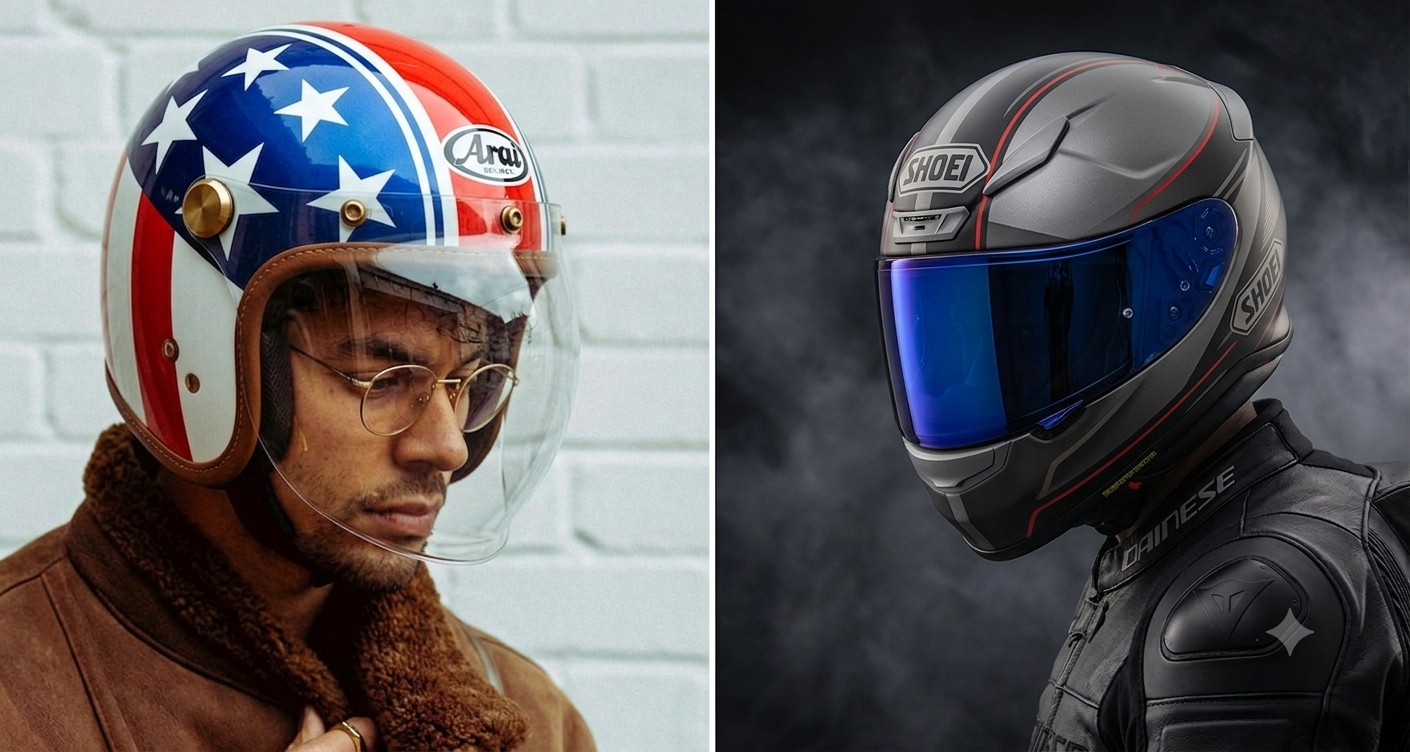
A full face helmet covers the entire head including the chin and jaw area. The defining feature is the chin bar – a rigid structural element that extends from the cheeks down to protect the lower face, jaw, and chin. A full face helmet has a single opening for the eyes covered by a removable visor.
Full face helmets are the most common type worn by sport, touring, and commuter riders. They provide the maximum coverage of any helmet type currently available and are the standard choice for riders who prioritise protection above other factors.
What Is an Open Face Helmet?
An open face helmet – also called a three-quarter helmet or jet helmet – covers the top, back, and sides of the head but leaves the face entirely exposed. There is no chin bar. The rider’s face, jaw, and chin receive no direct protection from the helmet structure itself.
Open face helmets are popular among urban commuters, scooter riders, classic bike enthusiasts, and riders who prioritise ventilation and situational awareness over maximum protection. They typically feel less claustrophobic than full face helmets and are easier to wear with goggles or sunglasses.
What Does the Research Say?
This is where the debate stops being a matter of preference and becomes a matter of evidence. Multiple independent studies have examined crash data across thousands of incidents to compare injury outcomes between full face and open face helmet wearers. The findings are consistent.
The Meta-Analysis Evidence
A comprehensive meta-analysis reviewed 702 studies on helmet effectiveness and selected six that met the required quality standards for inclusion, covering a combined 6,529 participants across data from Taiwan, Malaysia, Japan, and Brazil. The conclusion of this analysis was clear: a full face motorcycle helmet cuts the risk of head and cervical injuries by over half compared to open face and half-helmets.
That is not a marginal difference. Cutting injury risk by more than half is a substantial protective advantage that applies across different countries, road conditions, and crash types.
The Craniofacial Trauma Study
A retrospective study published in a peer-reviewed medical journal examined 440 patients admitted to two Level I Trauma Centres in Northern Italy between 2002 and 2019 for motorcycle-related craniofacial trauma. Of those patients, 288 wore open face helmets and 125 wore full face helmets at the time of their crash.
The findings confirmed what the meta-analysis suggested. Patients wearing open face helmets had a mean Comprehensive Facial Injury score of 7.0, and surgery was required in 149 cases – 51.7% of open face wearers. The full face group had significantly better outcomes across all measured injury categories, with lower facial fracture rates and reduced surgery requirements.
The study specifically noted that incorrectly fastened helmets were treated as equivalent to wearing no helmet at all, ensuring the data reflected genuine protective performance rather than being diluted by rider error.
The Facial Impact Research
Research published in the journal Accident Analysis and Prevention applied a new biomechanical test method using a complete THOR crash dummy to evaluate full face helmets, open face helmets, and an experimental airbag-equipped open face design. Facial impact tests were conducted at two locations – mid-face and lower face – measuring forces applied to the face and at the head-neck junction, with brain strain predicted by a finite element model.
The results showed a substantial reduction in brain strain and facial forces with the full face helmet compared to the open face alternative. This matters because facial impacts in crashes are not rare edge cases – they represent a meaningful proportion of real-world crash contacts.
Where Do Impacts Actually Occur?
Understanding the distribution of impact locations in motorcycle crashes helps explain why the chin bar makes such a significant difference. Hard Head Veterans summarised the research on this clearly: studies estimate facial injuries at 20 to 30 percent of all impact zones in motorcycle crashes, with jaw and face impacts consistently appearing in the 20 percent range across multiple independent datasets.
In practical terms, this means roughly one in five impact events in a motorcycle crash involves a zone that a full face helmet protects and an open face helmet does not. Across a large enough sample of crashes, that difference translates directly into the injury gap the studies consistently find.
The Chin Bar: Why It Makes Such a Difference
The chin bar is the structural element that separates full face helmets from open face alternatives, and its protective function is more significant than many riders realise.
The chin bar in a full face helmet does two things. First, it absorbs direct impact energy to the face and jaw in a frontal or forward-angular crash. Second, it maintains the structural integrity of the helmet shell during a crash sequence, preventing the helmet from collapsing inward toward the face even when impacted from another direction.
A study on facial impact protection confirmed that the chin bar also plays a role in reducing brain strain – not just facial injury. This is because the chin and jaw are mechanically connected to the skull, and a direct blow to an unprotected chin transmits force up through the jawbone to the skull and brain. The chin bar intercepts that force before it reaches the jaw, dispersing it across the helmet structure instead.
Practical Comparison: Full Face vs Open Face
The safety data is clear in favour of full face helmets, but riders make real-world choices that involve more than crash statistics. Here is an honest comparison of the practical factors that influence the choice.
Ventilation
Open face helmets are significantly more ventilated by design. With no chin bar blocking airflow across the face, wind moves freely across the rider’s face and around the helmet. For riders in hot climates or city traffic where speeds are lower and airflow is reduced, this can be a meaningful comfort advantage.
Full face helmets have improved dramatically in ventilation over the past decade, and current ECE 22.06 certified models from brands like AGV, HJC, and Shark move considerably more air than earlier generations. But they will never match the open face design for raw airflow at slow speeds, because the chin bar inherently restricts the largest single ventilation pathway across the face.
For riders in southern Europe including Spain, this is a relevant factor. The right full face helmet with good ventilation is manageable in summer heat. The wrong one in sustained city traffic in July is genuinely uncomfortable.
Situational Awareness
Open face helmet wearers often report better peripheral vision, better hearing, and a greater sense of connection to the riding environment. The absence of a chin bar also means normal conversation, eating, and drinking are possible without removing the helmet.
Full face helmets provide slightly reduced peripheral vision compared to open face designs, though current ECE 22.06 standards require a minimum field of vision that limits how much this can vary. Wind noise is typically lower in a full face helmet, which reduces fatigue on longer rides but also reduces ambient sound awareness.
Weight
Full face helmets are heavier than open face alternatives of equivalent construction. The chin bar adds structural mass that is absent from the open face design. For riders who spend long periods in the saddle, this difference in neck loading can become noticeable over a full day of riding.
Budget full face helmets tend to run around 1,400 to 1,600 grams. Comparable open face designs often come in at 1,000 to 1,200 grams. Premium carbon fibre full face helmets close the gap significantly, but at a considerably higher price.
Ease of Use
Open face helmets are faster to put on and take off, easier to wear with glasses, and simpler to combine with communication equipment. For commuters who stop frequently, remove their helmet at each stop, and wear prescription glasses, these practical factors have genuine daily relevance.
Full face helmets require more deliberate fitting and removal, though quick-release mechanisms on current models have reduced this significantly compared to older designs.
What About Modular Helmets?
Modular helmets – also called flip-up helmets – deserve a separate mention because they attempt to combine the protection of a full face design with the convenience of an open face.
A modular helmet has a chin bar that can be lifted and locked in the open position, converting the helmet to an open face configuration for stops, communication, or ventilation. When closed, the chin bar provides protection similar to a full face design.
The important qualification is that modular chin bars are mechanically hinged rather than structurally integrated. Independent testing has shown that modular chin bars typically offer less impact protection than fixed full face chin bars, because the hinge introduces a structural weak point that the fixed design does not have. Some premium modular helmets address this more effectively than budget alternatives, but the gap remains in most cases.
If you want the convenience of a modular design, buy from a reputable brand at a mid-range or premium price point, and check the specific certification. ECE 22.06 tests modular helmets in both the open and closed positions, which provides a minimum standard assurance.
Who Should Choose a Full Face Helmet?
The full face helmet is the right choice for the majority of riders in most circumstances. Specifically:
Riders who regularly exceed 80 km/h benefit significantly from full face protection, because impact severity increases with speed and the probability of a serious crash increases with speed-related exposure. The chin bar protection becomes more meaningful the faster you ride.
Sport and naked bike riders who adopt a forward-leaning position should prioritise full face helmets because their riding posture increases the probability of a frontal face impact in a crash compared to upright riders.
Riders who commute daily in mixed traffic, where low-speed collisions and tip-overs are statistically the most common accident type, still benefit from full face coverage because even low-speed face impacts on hard surfaces cause serious damage.
New riders who are still building their skills and judgment are in a higher-risk period of their riding career and should start with the maximum protection available.
Who Might Choose an Open Face Helmet?
The open face helmet is not an unreasonable choice for every rider in every situation, even given the safety data. There are specific circumstances where the trade-off may be acceptable:
Riders who use their motorcycle exclusively for very low-speed urban travel – scooter commuters navigating city centres at under 40 km/h – face a different risk profile from riders on open roads. The injury severity from a low-speed urban crash is meaningfully lower than a high-speed impact.
Riders with documented medical conditions that make wearing a full face helmet impractical – severe claustrophobia, hearing impairment that requires maximum situational awareness, or anatomical challenges with chin bar fit – may have legitimate reasons to prioritise open face designs.
Riders in warm climates who have tried multiple full face options and find that heat discomfort significantly affects their concentration and riding quality may decide the ventilation trade-off is worth accepting.
In all of these cases, the choice should be made with full awareness of the protective difference, not in ignorance of it.
The Compliance Factor
One argument sometimes made in favour of open face helmets is that riders who find full face designs uncomfortable are more likely to ride without a helmet at all, or to wear their full face helmet incorrectly. If a more comfortable open face helmet produces better compliance than an uncomfortable full face design, the real-world safety outcome might be better even if the per-crash protection is lower.
This argument has some theoretical validity but limited practical weight. The right response to an uncomfortable full face helmet is to find a full face helmet that fits correctly, not to downgrade to an open face design. The current market offers full face helmets at every price point, in multiple shell sizes and fit profiles, with varying internal geometries that suit different head shapes. There is no good reason why a rider cannot find a comfortable full face helmet if they invest appropriate time in finding the right fit.
Frequently Asked Questions
Is a full face helmet always safer than an open face helmet?
For the vast majority of riding situations, yes. The data from multiple independent studies consistently shows that full face helmets reduce head, facial, and cervical injury risk substantially compared to open face alternatives. The chin bar protection accounts for a significant portion of this advantage.
Are open face helmets legal in Europe?
Yes. Open face helmets that carry ECE 22.06 certification are legal for road use throughout Europe. The certification does not require a chin bar, only that the helmet meets the impact absorption and other standards tested at the covered zones.
Is a modular helmet as safe as a full face helmet?
A high-quality modular helmet closed provides protection close to a full face design, but the hinged chin bar is generally less structurally robust than a fixed chin bar. The gap is smaller in premium modular helmets. Always verify the specific ECE 22.06 rating of any modular helmet before purchasing.
Does helmet type matter more than helmet quality?
Both matter, but they affect different things. Helmet type determines which areas of the head and face are covered. Helmet quality – specifically the certification standard and materials used – determines how well the covered areas are protected. A high-quality open face helmet does not protect the chin. A low-quality full face helmet may not meet current standards even for the areas it covers. The ideal is a quality-certified full face helmet.
What is the best full face helmet for beginners?
The HJC C10 is one of the most recommended entry-level full face helmets in 2026. It was among the first helmets to achieve ECE 22.06 certification under 100 euros, making it an accessible starting point for new riders who want certified protection without a large upfront investment. Read our full guide to the best motorcycle helmets under 200 euros for a complete comparison.
Final Verdict
The question of full face vs open face helmet safety has a clear answer in the research: full face helmets provide significantly better protection, primarily because the chin bar covers impact zones that are involved in roughly 20 to 30 percent of crash contacts. The meta-analysis covering 6,529 participants found that full face helmets cut head and cervical injury risk by over half compared to open face alternatives. The craniofacial trauma study from Italian trauma centres confirmed the real-world injury gap between the two helmet types across 440 actual crash patients.
Open face helmets are not useless – they provide meaningful protection to the areas they cover and are significantly better than riding without a helmet. But they leave a substantial portion of the face, jaw, and chin unprotected, and that gap has measurable consequences in real crashes.
For most riders, most of the time, the full face helmet is the right choice. The ventilation and convenience advantages of an open face design are real but secondary to the protection difference. In a market where excellent full face helmets are available for under 100 euros with ECE 22.06 certification, there is no price barrier to choosing the safer option.
Wear a full face helmet. Make sure it fits. Fasten it correctly on every ride.
Disclosure: Gear4Moto uses affiliate links. If you purchase through a link on this page, we may earn a small commission at no extra cost to you. This does not influence our recommendations.