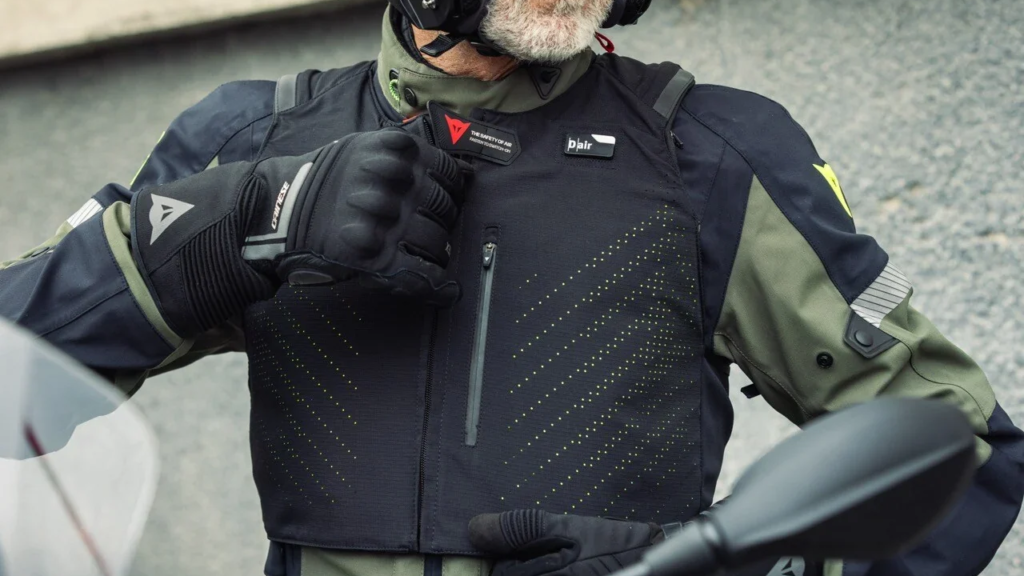
A good jacket protects you from abrasion and point impacts. An airbag vest does something no jacket can: it inflates in milliseconds and spreads the force of a crash across your chest, back and spine. Airbags used to be reserved for MotoGP riders and expensive touring suits. In 2026, you can buy a certified, standalone airbag vest for less than the price of a premium helmet. In this guide we compare the best motorcycle airbag vests of 2026, explain how they work and help you choose the right one for the way you ride.
What’s in this guide?
- How Motorcycle Airbag Vests Work
- EN 1621-4: What the Certification Means
- What to Look for in an Airbag Vest
- Our Top Picks at a Glance
- Best Overall: Alpinestars Tech-Air 3 V2
- Most Compact: Dainese Smart Air
- Best Value: Dainese Smart GO
- Best Coverage: Alpinestars Tech-Air 5
- Best Without Battery: Helite Turtle 2
- Best Off-Road: Alpinestars Tech-Air Off-Road
- How to Wear an Airbag Vest Correctly
- FAQ
- Our Verdict
How Motorcycle Airbag Vests Work
Every airbag vest has the same basic parts: an air bladder sewn into the vest, a small gas canister that fills it, and a trigger. The big difference is in that trigger. There are two types:
- Electronic (standalone): Sensors and an algorithm inside the vest detect a crash and fire the canister, with no connection to the bike. You charge it like a phone. All the Alpinestars and Dainese vests in this guide work this way.
- Tethered (mechanical): A cord connects the vest to your motorcycle. When you separate from the bike, the cord pulls a pin and the vest inflates. No battery, no charging, but you have to remember to clip in and out every time.
There is also a third group: airbag systems built into specific jackets, such as those using the In&Motion control box. They can be excellent, but you are tied to one garment, and some require a subscription for the crash-detection unit. We focused this guide on standalone vests you can wear with the gear you already own.
EN 1621-4: What the Certification Means
Motorcycle airbags are certified to the European standard EN 1621-4. Just like back protectors, they are rated per body zone at Level 1 or the stricter Level 2, which allows less force to pass through to your body. Look for Level 2 on both the chest and the back. If a manufacturer only lists one zone, the other zone has not been rated, or has not passed.
A warning: cheap no-name airbag vests on online marketplaces often have no valid certification at all, and independent tests have shown some inflate too slowly to help. Stick to established brands.
What to Look for in an Airbag Vest
- Coverage: Chest and back are the minimum. Some vests also protect the shoulders, ribs and neck.
- Over or under your jacket: Most vests can be worn both ways. Under a jacket, you need a few centimetres of space for the airbag to inflate, so your jacket may need to be a size larger.
- Battery life: Ranges from around 10 to 40 hours of riding. Long battery life matters if you tour.
- Running costs: After a crash, the gas canister must be replaced. On newer vests you can swap it yourself; older systems have to go back to the manufacturer. Some vests also need a periodic service.
- Riding style: Street algorithms are different from track and off-road algorithms. Buy a vest made for how you actually ride.
Our Top Picks at a Glance
| Vest | Category | Trigger | Certification | Price range |
|---|---|---|---|---|
| Alpinestars Tech-Air 3 V2 | Best Overall | Electronic | Level 2 chest & back | €€€ |
| Dainese Smart Air | Most Compact | Electronic | Level 2 chest & back | €€€ |
| Dainese Smart GO | Best Value | Electronic | Level 2 chest & back | €€ |
| Alpinestars Tech-Air 5 | Best Coverage | Electronic | Back certified | €€€€ |
| Helite Turtle 2 | Best Without Battery | Tethered | See review | €€€ |
| Alpinestars Tech-Air Off-Road | Best Off-Road | Electronic | Level 1 chest & back | €€€€€ |
Best Overall: Alpinestars Tech-Air 3 V2

The Tech-Air 3 is the vest that made airbags accessible to everyday riders, and the V2 fixes its biggest weakness. On the original, the gas inflator had to be replaced by a specialist after a deployment. On the V2, you can replace it yourself, so you are back on the road much sooner and for less money.
It is fully self-contained, with three gyroscopes and three accelerometers that monitor your movement every millisecond. Alpinestars quotes an inflation time of around 50 milliseconds. The street algorithm can even detect being hit from behind while you are standing still at traffic lights. Protection is certified to EN 1621-4 Level 2 at both the chest and the back, and the battery lasts up to 40 hours of riding, the longest in this guide. You can wear it over or under your jacket, and there is a pocket for an optional passive back protector.
The trade-offs: it is warm on hot days, especially under a jacket, and it looks bulky when worn over your gear. The V2 Canvas version is also slightly heavier than the original.
| Trigger | Electronic, standalone (no bike connection) |
| Certification | EN 1621-4 Level 2, chest and back |
| Coverage | Chest, back and collarbones |
| Battery | Up to 40 hours of riding, USB-C charging |
| After a crash | User-replaceable inflator |
| Wear | Over or under your jacket |
| Pros | Cons |
|---|---|
| Level 2 certified at chest and back | Warm in summer, especially under a jacket |
| Longest battery life in this guide | Looks bulky over a jacket |
| Inflator now user-replaceable | Needs a periodic service |
| Detects crashes while stationary | |
| Works with the gear you already own |
Our rating: 9.2/10
Most Compact: Dainese Smart Air

The Dainese Smart Air is the slimmest electronic vest in this guide. It is the successor to the popular Dainese Smart Jacket, the airbag we also recommended in our Ducati Diavel V4 2027 article, and it uses Dainese’s D-air technology, originally developed in racing. Like the Tech-Air 3, it is self-contained and does not need a subscription.
Protection is certified to EN 1621-4 Level 2 at the chest and back, and the vest also covers the shoulders. Its D-air app receives software updates over the air. A handy EV mode keeps the vest armed from the moment you switch it on, which is useful on electric bikes that do not vibrate at a standstill. After a crash, you can replace the gas generator yourself up to three times.
The compromise is battery life. Dainese claims up to 18 hours, but independent testers measured closer to 10 to 12 hours of real riding, and the low-battery warning is a light rather than a vibration. Sizing also runs small, so try before you buy if you can.
| Trigger | Electronic, standalone (no bike connection) |
| Certification | EN 1621-4 Level 2, chest and back |
| Coverage | Chest, shoulders and central back |
| Battery | Up to 18 hours claimed, USB-C charging |
| After a crash | User-replaceable gas generator (up to 3 times) |
| Wear | Over or under your jacket (over works best) |
| Pros | Cons |
|---|---|
| Very slim and light to wear | Shorter real-world battery life |
| Level 2 certified at chest and back | Sizing runs small |
| Generator replaceable at home | Low-battery warning is easy to miss |
| Over-the-air software updates | Covers less of the body than bulkier vests |
Our rating: 8.9/10
Best Value: Dainese Smart GO

The Smart GO is Dainese’s newest airbag, launched in October 2026, and it changes the price of entry. It is a fully electronic, standalone vest with EN 1621-4 Level 2 certification at the chest and back, and it costs noticeably less than the other electronic vests in this guide. Dainese says you can wear it without an additional rigid back protector.
To keep the price and weight down, the Smart GO has no large internal battery. Instead, it draws power over USB-C from a compatible smartphone or from Dainese’s optional power bank, which gives up to 72 hours of riding. At 780 grams, it is light enough to pack into a backpack or under a scooter seat. One size with adjustable straps fits a wide range of riders, and you can replace the gas generator yourself up to three times. An optional magnetic 15-litre backpack is sold separately.
It is designed for road riding and light off-road use, not for the track. And because it is brand new, long-term real-world reviews are still to come. We will update this guide as soon as we know more.
| Trigger | Electronic, standalone (no bike connection) |
| Certification | EN 1621-4 Level 2, chest and back |
| Weight | 780 g including gas generator |
| Power | USB-C from smartphone or optional power bank (up to 72 hours) |
| After a crash | User-replaceable gas generator (up to 3 times) |
| Use | Road and light off-road, not track |
| Pros | Cons |
|---|---|
| Lowest price for a Level 2 electronic vest | Needs a phone or power bank for power |
| Very light at 780 g | Not suitable for track riding |
| Packs small, easy to take anywhere | Brand new: no long-term reviews yet |
| Generator replaceable at home |
Our rating: 8.7/10
Best Coverage: Alpinestars Tech-Air 5

Where the Tech-Air 3 focuses on the chest and back, the Tech-Air 5 protects a much larger area: back, chest, ribs, shoulders, upper arms and collarbones, plus support for the head and neck. It is the closest thing to a full airbag suit that you can wear with your own jacket. A CE Level 1 passive back protector is included.
It is more expensive than the Tech-Air 3 and the battery lasts up to 30 hours instead of 40. One thing to know: only the back area is certified under EN 1621-4, so the chest performance has not been officially rated. If certified chest protection is your priority, the Tech-Air 3 V2 is the safer bet. If you want the widest coverage, especially for your shoulders and neck, the Tech-Air 5 is hard to beat.
| Trigger | Electronic, standalone (no bike connection) |
| Certification | EN 1621-4, back area |
| Coverage | Back, chest, ribs, shoulders, upper arms, collarbones, head/neck support |
| Battery | Up to 30 hours of riding |
| Included | CE Level 1 passive back protector |
| Wear | Over or under your jacket |
| Pros | Cons |
|---|---|
| Widest coverage in this guide | Chest area not certified under EN 1621-4 |
| Shoulder and head/neck support | Higher price |
| Passive back protector included | Shorter battery life than the Tech-Air 3 |
Our rating: 8.6/10
Best Without Battery: Helite Turtle 2
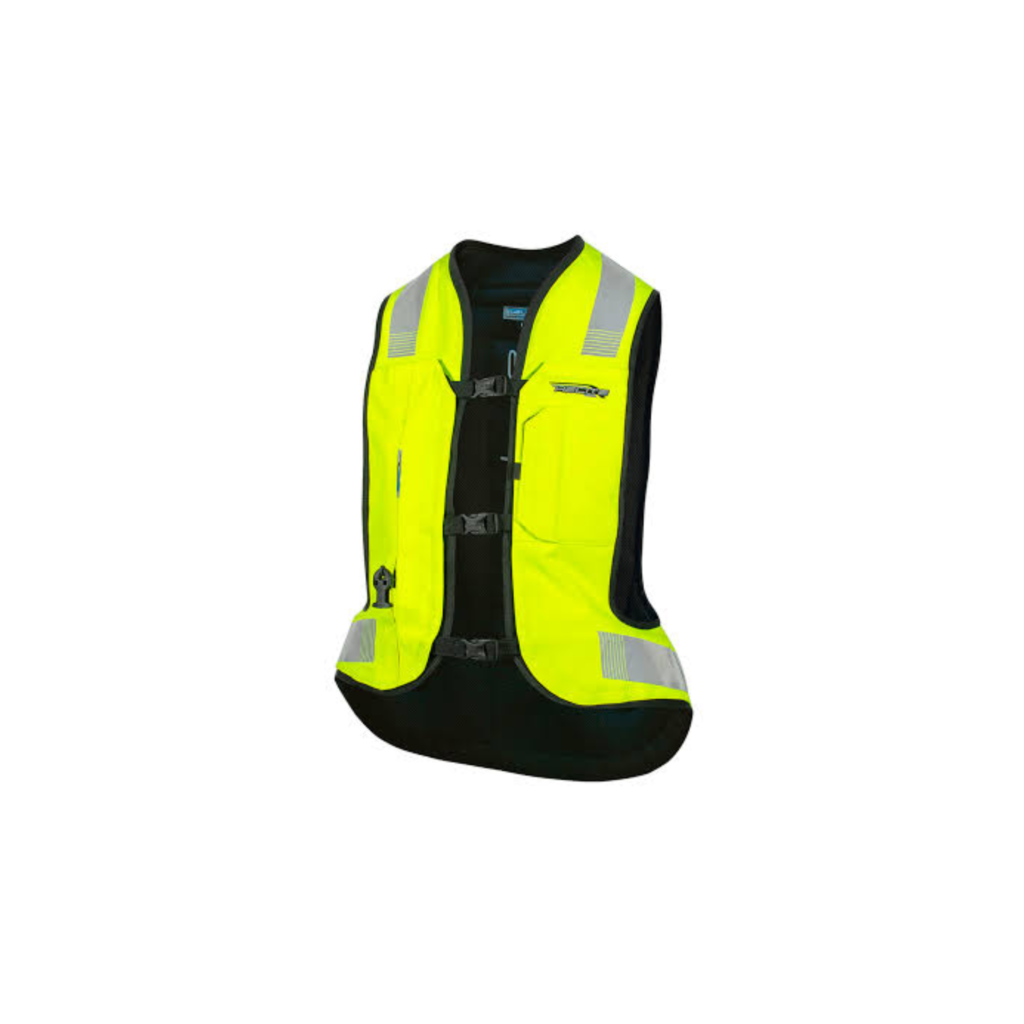
Not everyone wants another device to charge. The Helite Turtle 2 is a tethered airbag: a cord connects the vest to your bike, and when you are thrown off, the cord releases and the vest inflates. No battery, no app, no software. It just works whenever you are clipped in.
Its strong point is the large collar that supports your head and neck. It is worn over your other gear. The downsides are real, though. A tethered system cannot detect a collision where you stay on the bike, such as being hit while standing still. In independent tests by the French lab CRITT, it scored lower on deployment speed and chest protection than the electronic vests above. Helite also offers an electronic version, the e-Turtle 2, which costs considerably more.
| Trigger | Tethered (mechanical, cord to the bike) |
| Coverage | Back and chest, with head and neck support |
| Battery | None needed |
| After a crash | Replace the gas cartridge |
| Wear | Over your jacket only |
| Pros | Cons |
|---|---|
| No battery or charging | Must clip in and out every ride |
| Strong head and neck support | Cannot detect crashes when you stay on the bike |
| Simple, proven technology | Slower deployment and weaker chest scores in tests |
| Over-the-jacket only |
Our rating: 7.6/10
Best Off-Road: Alpinestars Tech-Air Off-Road
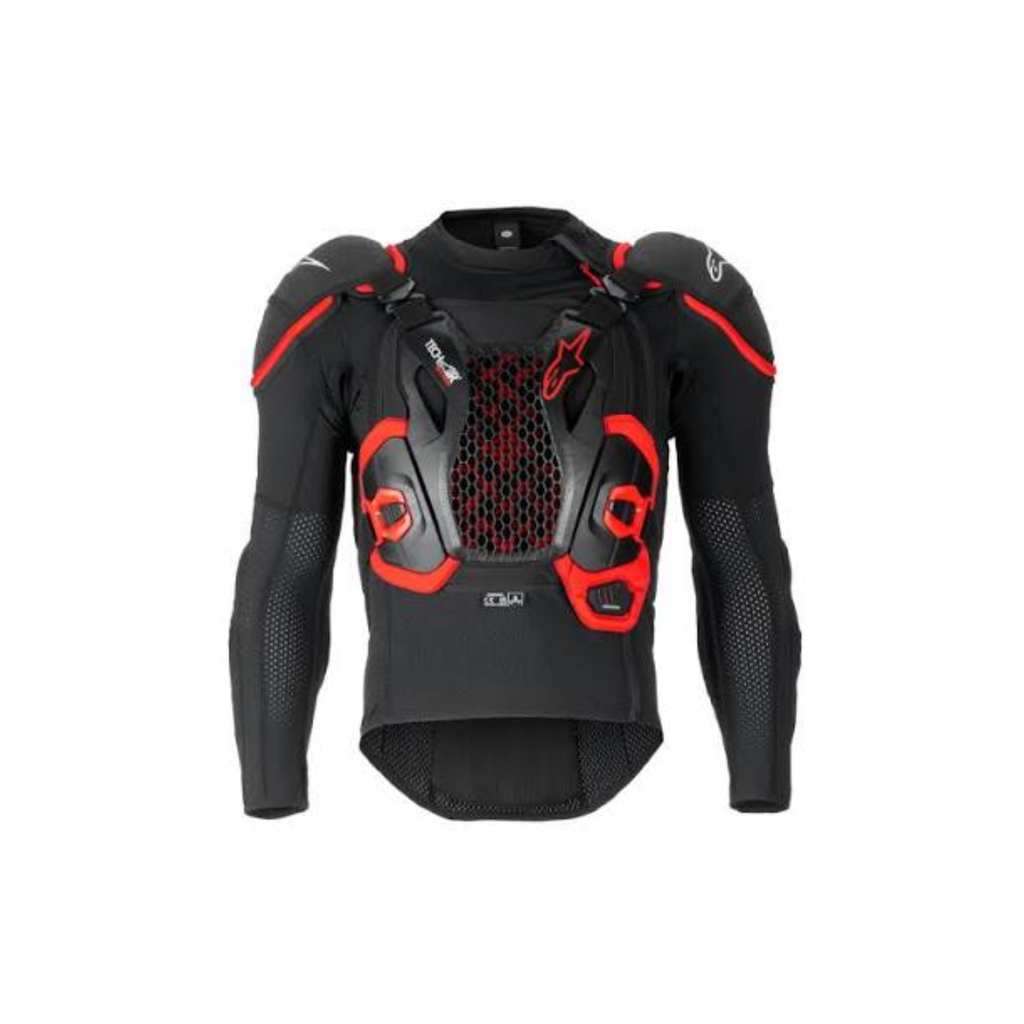
Street airbag algorithms are not built for the jumps, drops and constant movement of off-road riding. The Tech-Air Off-Road uses a dedicated off-road algorithm and is designed to be worn on its own, with passive armour and limb protectors built in. So you wear it as your main upper-body protection, not as an extra layer.
It is certified to EN 1621-4 Level 1 at the chest and back, and it is the most expensive vest in this guide. For enduro and adventure riders who spend serious time off the tarmac, it is the most complete solution. If you are just getting into off-road riding, start with our guide to choosing your motocross gear.
| Trigger | Electronic, off-road algorithm |
| Certification | EN 1621-4 Level 1, chest and back |
| Coverage | Chest and back airbag, plus passive armour and limb protectors |
| Wear | Standalone, as your main upper-body protection |
| Pros | Cons |
|---|---|
| Purpose-built off-road algorithm | Most expensive vest in this guide |
| Airbag and passive armour in one | Level 1, not Level 2 |
| Worn on its own, no extra layer needed | Overkill for road riders |
Our rating: 8.3/10
How to Wear an Airbag Vest Correctly
- Leave room to inflate: Under a jacket, an airbag needs around 4 to 8 centimetres of space around your torso. If your jacket is already snug, buy it one size larger or wear the vest on top. Spacious touring jackets, like the one in our REV’IT Tornado 4 H2O review, are often a good match.
- Get the fit right: The vest must sit close to your body. A loose vest moves around and inflates in the wrong place.
- Keep your armour: An airbag does not replace the shoulder and elbow armour in your jacket. Read our leather vs textile jacket comparison to choose the right base.
- Charge before every ride: Make charging part of your routine, just like checking your tyres. A flat airbag is no airbag.
- Mind your backpack: Check the manufacturer’s advice before wearing a backpack over your vest. See our motorcycle backpack guide for options.
FAQ
Is a motorcycle airbag vest worth it?
If you ride regularly, yes. A good airbag vest protects your chest, back and spine far better than passive armour alone, and with prices starting well under the cost of a premium helmet, it is one of the best safety upgrades you can buy. Get your basics right first: a good helmet (see our helmet buyer’s guide), gloves and a jacket with armour.
Can I wear an airbag vest under my normal jacket?
Most electronic vests in this guide can be worn over or under your jacket. Under a jacket, you need enough space for the airbag to inflate. If your jacket is tight, wear the vest over it or buy a jacket one size larger.
What happens after an airbag vest deploys?
The gas canister is empty and must be replaced. On the Alpinestars Tech-Air 3 V2 and the Dainese Smart Air and Smart GO, you can replace it yourself. After several deployments, or if the vest is damaged, the airbag itself needs to be checked or replaced by the manufacturer.
What is the difference between the Dainese Smart Jacket and the Smart Air?
The Smart Air is the newer, slimmer successor to the Smart Jacket. Both are standalone electronic vests from Dainese. The Smart Air has Level 2 certification at the chest and back and a user-replaceable gas generator, while independent tests rated the Smart Jacket’s back just below Level 2. The Smart Jacket does offer longer battery life.
Do I need a subscription for an airbag vest?
Not for any of the vests in this guide. Some airbag systems that are built into specific jackets use a control box that you either buy outright or rent with a subscription. Standalone vests from Alpinestars, Dainese and Helite are a one-time purchase, apart from servicing and replacement canisters.
Our Verdict
An airbag vest is the biggest step up in protection most riders can make today. Here’s our quick summary:
- Best for most riders: Alpinestars Tech-Air 3 V2, Level 2 chest and back with the longest battery life
- Most compact: Dainese Smart Air, the slimmest vest to wear every day
- Best value: Dainese Smart GO, Level 2 protection at the lowest price
- Widest coverage: Alpinestars Tech-Air 5, with shoulder and neck protection
- No charging needed: Helite Turtle 2, the simple tethered option
- Off-road: Alpinestars Tech-Air Off-Road
Whatever you choose, check for EN 1621-4 certification, make sure it fits with room to inflate and keep it charged. And don’t forget your hands: in a crash, they hit the ground first. Our guide to the best Alpinestars gloves helps you choose the right pair.
All gear recommendations link to Amazon. Gear4Moto participates in the Amazon affiliate programme — we earn a small commission on qualifying purchases at no extra cost to you. We only recommend gear we consider genuinely worth buying.