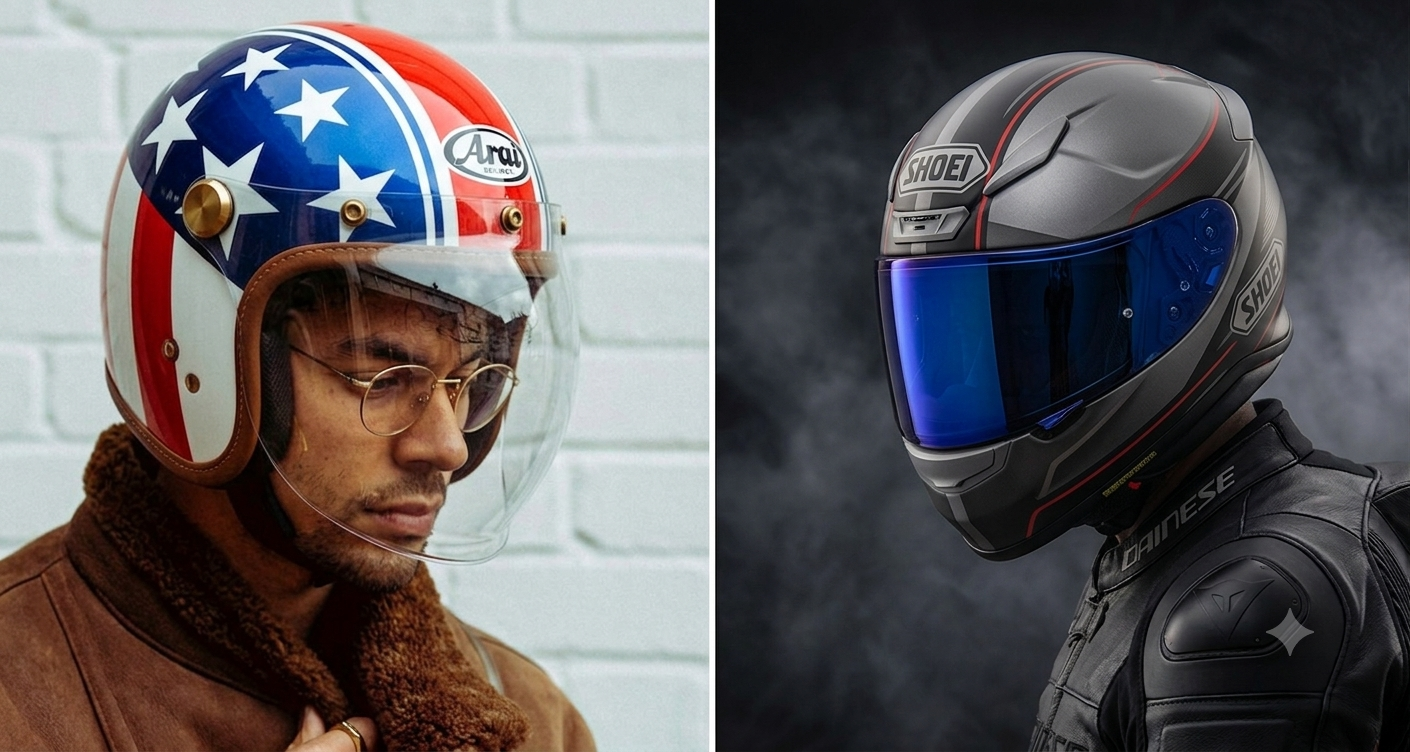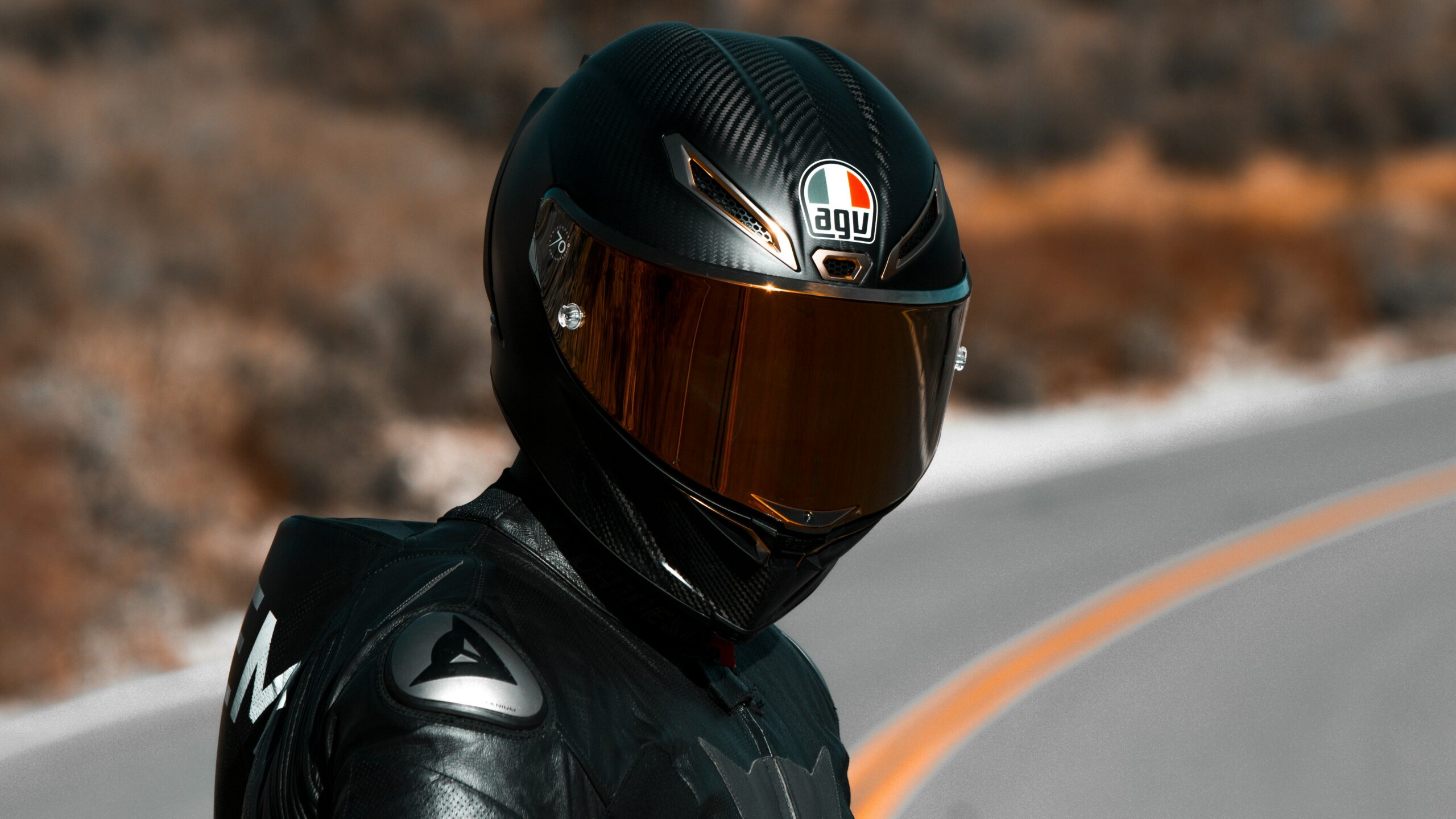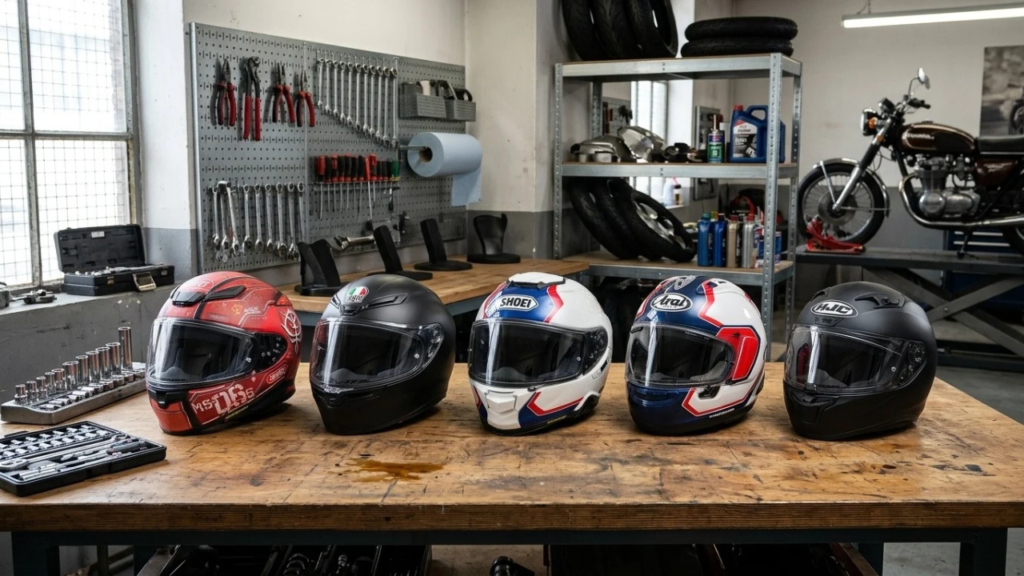
Your helmet is the single most important piece of gear you own. Not your jacket, not your boots — your helmet. It’s the difference between walking away and not. In this guide, we break down the best motorcycle helmets available on Amazon in 2026, across every budget and riding style — from track-focused full-face lids to comfortable touring helmets.
Quick note on certifications: We only recommend helmets with ECE 22.06 certification — the strictest standard in Europe. If a helmet only carries DOT or an older ECE rating, it doesn’t make this list.
What’s in this article?
What to Look for in a Motorcycle Helmet
Before we get to the picks, here’s what actually matters when choosing a helmet:
- Certification: ECE 22.06 is the gold standard. Look for it on the inside of the chin strap.
- Fit: The most important factor. A €500 helmet that doesn’t fit is worse than a €150 one that does. Try before you buy if possible — different brands suit different head shapes.
- Type: Full-face gives maximum protection. Modular (flip-up) is convenient for touring. Open-face is not recommended for high-speed riding.
- Weight: Lighter is better for comfort, especially on long rides. Under 1,400g is the sweet spot for full-face.
- Ventilation: Critical for summer riding. More vents = more comfort, but also more noise.
- Visor system: Pinlock-ready visors are a must — they prevent fogging. Sun visors (drop-down internal) are a significant quality-of-life upgrade.
Our Top Picks at a Glance
| Helmet | Category | Certification | Weight | Price range |
|---|---|---|---|---|
| Shoei NXR2 | Best Overall | ECE 22.06 | ~1,395g | €€€ |
| AGV K6 S | Best Lightweight | ECE 22.06 | ~1,279g | €€€ |
| Arai Quantic | Best Premium | ECE 22.06 | ~1,450g | €€€€ |
| HJC RPHA 11 Pro | Best Mid-Range | ECE 22.06 | ~1,400g | €€ |
| Shoei GT-Air 3 | Best Touring | ECE 22.06 | ~1,550g | €€€ |
| Bell Race Star Flex DLX | Best Track | ECE 22.06 | ~1,420g | €€€ |
| HJC i10 | Best Budget | ECE 22.05 | ~1,350g | € |
Best Overall: Shoei NXR2
The Shoei NXR2 is simply the most well-rounded full-face helmet money can buy without stepping into extreme premium territory. It’s the helmet we’d recommend to 80% of riders. Excellent aerodynamics, superb ventilation, a smooth and refined Pinlock-ready visor, and Shoei’s legendary build quality — all in a package that ECE 22.06 certifies for real-world safety.
The fit is typically oval to slightly round oval, making it ideal for most European and Asian head shapes. The interior is plush, fully removable and washable. At highway speed, wind noise is well-controlled — better than most helmets at this price point.
| Pros | Cons |
|---|---|
| Superb build quality and finish | No integrated sun visor |
| Excellent ventilation | Premium price |
| Very aerodynamic at speed | Fit can be tight for round head shapes |
| ECE 22.06 certified | |
| Pinlock 120 EVO lens included | |
| Comfortable for all-day wear |
Our rating: 9.2/10
Best Lightweight: AGV K6 S
At just 1,279g, the AGV K6 S is one of the lightest full-face helmets on the market — and it doesn’t compromise on protection to get there. The carbon composite shell absorbs impacts exceptionally well, and the aerodynamic profile makes it a natural match for sport and supersport riders.
The visor mechanism is smooth and tool-free, the ventilation is aggressive (arguably the best on this list for hot-weather riding), and the integrated sun visor adds real-world convenience. The fit runs slightly narrow — ideal for oval head shapes, less so for rounder heads.
| Pros | Cons |
|---|---|
| Exceptionally lightweight (1,279g) | Narrower fit — not ideal for round heads |
| Outstanding ventilation | Pinlock not included (Pinlock ready) |
| Integrated drop-down sun visor | Premium price |
| ECE 22.06 certified | Noisier than Shoei at highway speeds |
| Premium carbon composite shell | |
| Excellent aerodynamics |
Our rating: 9.0/10
Best Premium: Arai Quantic
Arai is in a league of its own when it comes to shell technology. The Quantic uses Arai’s proprietary PB-SNC2 shell — a hand-laid fibreglass composite designed to glance off impacts rather than absorb them in one spot. It’s a fundamentally different engineering philosophy to most helmets, and many safety experts argue it’s the safer approach for real-world crashes.
It’s heavier than the AGV and noisier than the Shoei, but no helmet on this list matches its long-term durability or the precision of its fit. Arai helmets are also fully serviceable — you can replace almost every part.
| Pros | Cons |
|---|---|
| Industry-leading shell technology | Heavy compared to carbon alternatives |
| Fully serviceable — replace any part | No integrated sun visor |
| Exceptional long-term durability | Very high price |
| ECE 22.06 certified | Ventilation less impressive than AGV |
| Superb interior comfort | |
| Multiple shell sizes (better fit per head size) |
Our rating: 9.3/10
Best Mid-Range: HJC RPHA 11 Pro
The HJC RPHA 11 Pro is the helmet that makes you question why anyone spends more. It offers premium-level aerodynamics, a carbon composite shell, excellent ventilation, and a smooth integrated sun visor — all for significantly less than a Shoei or Arai. It’s the choice of riders who want performance without the premium logo markup.
HJC supplies helmets to MotoGP teams — the RPHA 11 Pro is derived directly from race-proven technology. The fit tends to suit round-oval head shapes. The only real compromise vs. the Shoei NXR2 is slightly higher noise levels and a less refined visor mechanism.
| Pros | Cons |
|---|---|
| Excellent value for money | More road noise than Shoei |
| Carbon composite shell | Visor mechanism less refined |
| Integrated drop-down sun visor | Narrower head shape compatibility |
| ECE 22.06 certified | |
| Race-proven aerodynamics | |
| Pinlock included |
Our rating: 8.8/10
Best Touring: Shoei GT-Air 3
If you spend more than two hours in the saddle on a regular basis, the Shoei GT-Air 3 is worth every penny. The integrated sun visor is excellent — smooth, one-finger operation, with no distortion. The chin curtain keeps cold air out at speed. The interior is plush and pressure-free for all-day comfort. And the Shoei-quality build means it’ll still feel tight after 50,000 km.
It’s slightly heavier than the NXR2 — expected for a touring helmet — but Shoei has done an exceptional job keeping neck fatigue to a minimum through aerodynamic shaping. Bluetooth intercom systems fit easily through the speaker pockets.
| Pros | Cons |
|---|---|
| Outstanding integrated sun visor | Heavier than sports-focused helmets |
| All-day comfort | Premium price |
| Excellent wind noise suppression | Less ventilation than AGV K6 S |
| ECE 22.06 certified | |
| Bluetooth intercom ready | |
| Chin curtain included |
Our rating: 9.1/10
Best Track: Bell Race Star Flex DLX
The Bell Race Star Flex DLX is the track helmet for riders who want premium protection without paying Arai or Shoei race-spec money. The key technology is Bell’s Flex Impact Liner — a dual-density system that handles both low-speed and high-speed impacts more effectively than standard EPS foam alone. SHARP gives it a 5-star rating.
The visor changes are fast and tool-free — important at track days. The interior is fully removable and washable, and the aerodynamic chin bar keeps the helmet stable at triple-digit speeds without excessive neck strain.
| Pros | Cons |
|---|---|
| 5-star SHARP rating | No integrated sun visor |
| Flex Impact Liner technology | Fit suits narrower head shapes |
| Fast tool-free visor changes | Less refined interior than Shoei |
| ECE 22.06 certified | |
| Stable at high speed | |
| Competitive pricing vs Shoei/Arai |
Our rating: 8.9/10
Best Budget: HJC i10
Not everyone can spend €400+ on a helmet. The HJC i10 is the best-performing budget helmet we’ve tested — and it’s the one we’d recommend to new riders who need solid protection while they figure out what they want long-term.
It carries ECE 22.05 (not the newer .06 standard), but it performs well in independent SHARP testing. The polycarbonate shell is lightweight, ventilation is decent for the price, and the interior is comfortable and washable. The visor is Pinlock ready — though the Pinlock itself costs extra.
Important: At this price point, don’t expect the refinement of a Shoei. The visor mechanism has more play, wind noise is higher, and the interior feels less premium. But for under €100, it’s hard to beat for everyday use.
| Pros | Cons |
|---|---|
| Excellent value at under €100 | ECE 22.05 (not .06) |
| Lightweight polycarbonate shell | Higher wind noise |
| Decent ventilation for the price | Less refined visor mechanism |
| Comfortable and washable interior | No sun visor |
| Pinlock-ready visor | Not suitable for track use |
Our rating: 7.8/10
How to Choose the Right Size
Sizing varies significantly between brands. Here’s how to measure correctly:
- Measure your head circumference — wrap a soft tape measure around your head, about 2.5cm above your eyebrows and ears. Note the measurement in centimetres.
- Check the brand’s size chart — a size M at Shoei (57–58cm) may differ from size M at HJC (57cm). Always check the specific chart.
- Try it on if possible — the helmet should feel snug but not painful. If you can rock it up and down on your head, it’s too big. If you feel pressure points after 2 minutes, try the next size up or a different brand.
- Account for break-in — most helmet interiors compress 10–15% over the first 15–20 hours of use. A helmet that feels very slightly snug when new will likely be perfect after break-in.
Frequently Asked Questions
How often should I replace my motorcycle helmet?
Every 5 years as a general rule — sooner if you’ve dropped it or been in a crash, even at low speed. UV rays and sweat degrade the EPS foam lining invisibly over time. When in doubt, replace it.
Is ECE 22.06 really that much better than ECE 22.05?
Yes. The 22.06 standard introduced rotational impact testing for the first time — this tests the oblique impacts that cause most serious brain injuries in real crashes. It’s a meaningfully better standard, not just a minor update.
Can I buy a second-hand helmet?
We strongly advise against it. You have no way of knowing whether the helmet was dropped or involved in a crash. EPS foam damage is invisible to the naked eye. Buy new.
Is Arai really worth the extra money over Shoei?
It depends on what you value. Arai’s shell technology is unique and arguably safer in real-world oblique impacts. Shoei offers a more refined, quieter, more user-friendly experience. Both are exceptional helmets. If you’re doing track days, consider Arai. If you’re a road rider, the Shoei NXR2 is hard to beat.
Does a more expensive helmet mean better protection?
Not automatically. A well-fitting budget helmet that passes ECE 22.06 will outperform a premium helmet that fits poorly. Fit is the single biggest factor. That said, premium helmets do offer better materials, more consistent manufacturing, and better real-world performance in complex impact scenarios.
Our Verdict
If you can only take one thing from this guide: fit matters more than brand. Try as many helmets as you can before buying. But if you need a starting point, here’s our quick summary:
- Best all-rounder: Shoei NXR2 — most riders, most situations
- Best value: HJC RPHA 11 Pro — premium performance, mid-range price
- Best lightweight: AGV K6 S — sport and supersport riders
- Best touring: Shoei GT-Air 3 — long-distance comfort
- Best premium: Arai Quantic — the last helmet you’ll ever need
- Best budget: HJC i10 — solid starter helmet under €100
Whatever you choose, make sure it carries ECE 22.06, that it fits correctly, and that you replace it every five years. Your head is worth it.
All gear recommendations link to Amazon. Gear4Moto participates in the Amazon affiliate programme — we earn a small commission on qualifying purchases at no extra cost to you. We only recommend gear we consider genuinely worth buying.