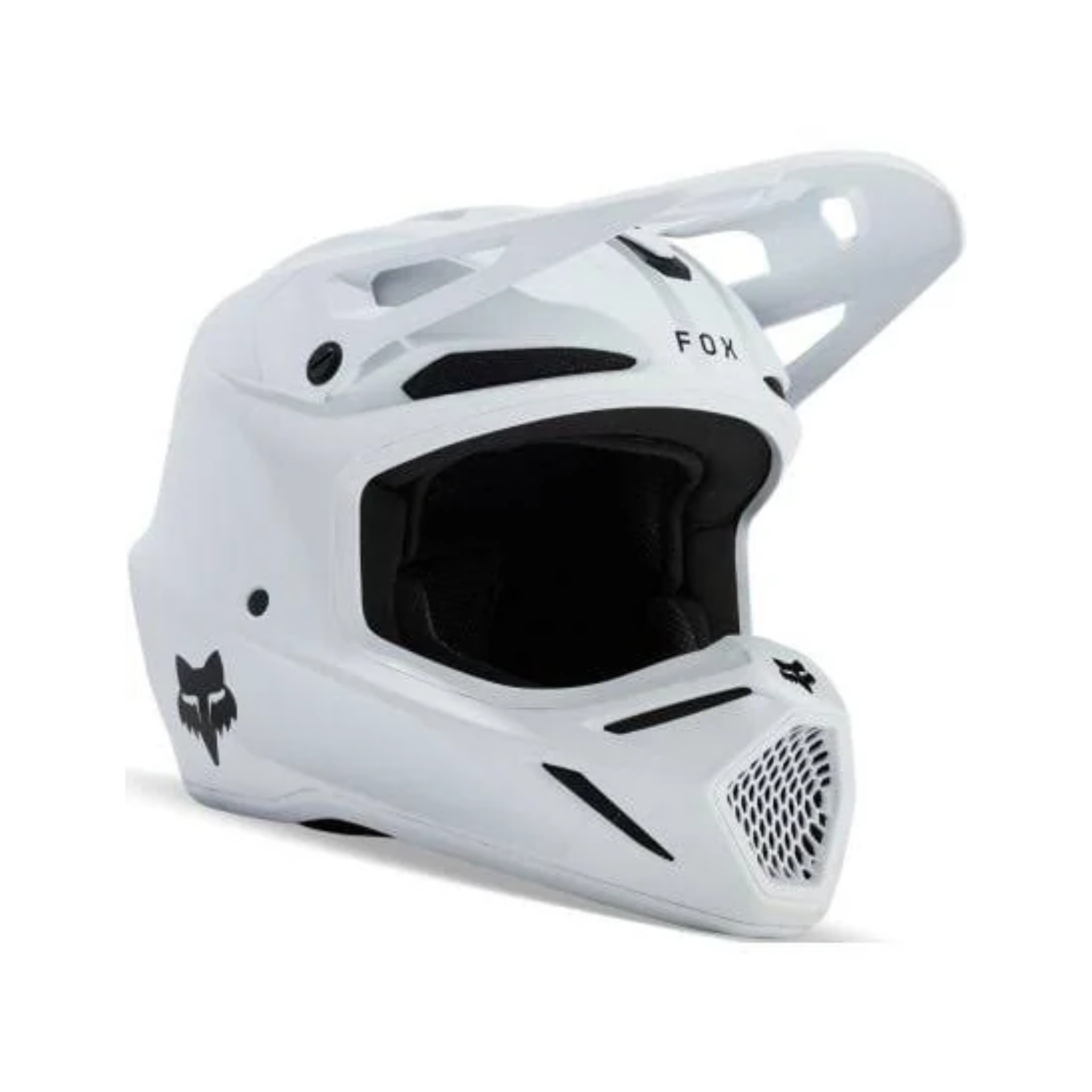
The Fox V3 helmet is the helmet you see in every pit lane, from club motocross to the AMA paddock. It sits in the middle of Fox’s range, below the carbon V3 RS and above the entry-level V1, and for most riders that is exactly where the sweet spot is. It brings ECE 22.06 and DOT certification, MIPS rotational protection as standard and a weight of around 1,270 grams, at roughly half the price of the RS. In this review we look at what you get, where it falls short and who should buy it.
What’s in this review?
- Fox V3 at a Glance
- Who Is the Fox V3 For?
- Protection: ECE 22.06, MIPS and a Dual-Density Liner
- Fit and Comfort
- Ventilation and Hydration
- Peak, Goggles and Accessories
- Fox V3 vs V3 RS: Is the Upgrade Worth It?
- How to Find the Right Size
- Completing Your Off-Road Setup
- Pros and Cons
- FAQ
- Our Verdict
Fox V3 at a Glance
| Specification | Fox V3 MIPS |
|---|---|
| Type | Off-road / motocross helmet |
| Shell | Composite fibreglass |
| Liner | MDEPS: dual-density EPS with EPP |
| Rotational protection | MIPS (standard) |
| Certification | ECE 22.06 and DOT |
| Weight (size M) | Approx. 1,270 g (±50 g) |
| Sizes | Youth YS–YL and adult XS–XXL |
| Comfort liner | Ionic+ moisture-wicking, removable and washable |
| Peak | 3-position breakaway peak with clip-on extension |
| Safety extras | Emergency cheek pad removal (Eject-compatible) |
| Extras | Hydration routing, speaker pockets, helmet bag |
| Closure | Double D-ring |
Who Is the Fox V3 For?
The V3 is aimed at riders who take their off-road riding seriously but don’t want to pay carbon-helmet money. Think weekend motocross riders, enduro and trail riders, and club racers. It is also a smart first “proper” helmet for riders upgrading from an entry-level lid, because it brings the current safety standard and MIPS without asking for a premium price.
If you are just starting out and still putting together your kit, read our complete guide to choosing motocross gear first. It explains which pieces matter most and how to split your budget.
Protection: ECE 22.06, MIPS and a Dual-Density Liner
Protection is where the V3 earns its reputation. The helmet is certified to ECE 22.06, the current European standard, which tests impacts at more points on the shell, at both high and low speeds, and includes a rotational impact test. It also carries DOT approval for the US market. Not sure what these labels mean? Our helmet buyer’s guide explains ECE 22.06 and what to look for in plain language.
Inside the composite fibreglass shell sits Fox’s MDEPS liner. It combines EPS foam of different densities with EPP, a more elastic foam that recovers its shape after smaller hits. The softer zones absorb the lower-speed knocks that are common off-road, while the firmer foam handles big impacts.
On top of that comes MIPS as standard. Most off-road crashes are not straight-line impacts: you land at an angle and your head is twisted on impact. MIPS adds a low-friction layer that lets the helmet move a few millimetres relative to your head, which helps reduce the rotational forces reaching the brain. Some rivals at this price still charge extra for it; on the V3 it is simply included.

Fit and Comfort
Fox helmets are known for a snug, slightly long-oval fit, and the V3 is no exception. Riders with an intermediate-oval head shape generally get on well with it; riders with a very round head may feel pressure at the sides. The fit is firm out of the box and beds in after a few rides, but it should never cause hot spots on your forehead. If it does, it is the wrong size or the wrong shape for you.
The Ionic+ comfort liner and cheek pads wick moisture away from your skin and can be removed and washed, which you will want to do often after dusty or muddy days. The cheek pads have an emergency removal system with pull tabs, so medics can take the helmet off without moving your neck after a crash. It is a small feature that matters a lot when it counts.
Ventilation and Hydration
Off-road riding is hard physical work, and a helmet that traps heat drains your energy fast. The V3 uses induction vents at the front that force air over your head, with exhaust ports at the rear to pull warm air out. Airflow is good for a mid-range helmet, although the carbon V3 RS, with extra top vents and a cooling liner, does run a little cooler on hot summer days.
A practical bonus is the hydration routing: the helmet has a channel for a hydration-pack hose and comes with a compatible mouthpiece, so you can drink without stopping. For long enduro rides and hot track days, that alone is a reason to consider the V3.
Peak, Goggles and Accessories
Like every motocross helmet, the V3 has no visor; you wear goggles instead. The eyeport is wide and works with most popular goggle brands, including Fox’s own range. The 3-position peak can be set higher or lower to block the sun, and it is designed to break away in a crash so it can’t catch the ground and twist your neck. Spare peak hardware is included.
Fox also includes a clip-on peak extension, which is handy in low sun, and a padded helmet bag. Speaker pockets in the liner leave room for a comms system, which is useful for group trail and adventure rides.
Fox V3 vs V3 RS: Is the Upgrade Worth It?
The big question for many riders is whether to stretch to the V3 RS. Here are the key differences:
| Feature | Fox V3 | Fox V3 RS |
|---|---|---|
| Shell | Composite fibreglass | Carbon fibre |
| MIPS | MIPS (standard) | MIPS Integra Split (two EPS layers) |
| Weight (size M) | Approx. 1,270 g | Approx. 1,270–1,280 g, smaller shell |
| Ventilation | Induction and exhaust vents | Extra top vents, cooling liner |
| Accessories | Peak extension, spare hardware, bag | Adds spare peak, mud visor and extra cheek pads |
| Sizes | Youth and adult | Adult only |
| Price level | Mid-range | Roughly double |
Interestingly, the RS is not much lighter on the scale. What you pay for is the carbon shell, the more advanced MIPS Integra Split system, slightly better cooling and a fuller accessory kit. For racers and riders who spend many hours a week on the bike, that can be worth it. For most weekend riders, the standard V3 delivers the same certification and the bulk of the protection for far less money.
How to Find the Right Size
Measure the circumference of your head about one finger-width above your eyebrows, around the widest point at the back. Then compare it with Fox’s size chart:
| Size | Head circumference |
|---|---|
| XS | 53–54 cm |
| S | 55–56 cm |
| M | 57–58 cm |
| L | 59–60 cm |
| XL | 61–62 cm |
| XXL | 63–64 cm |
If you are between two sizes, try the smaller one first; the liner will settle slightly with use. A correctly fitting helmet should not move when you shake your head, and when you push the chin bar up, the skin on your forehead should move with it. Always check the latest size chart on the product page before ordering.
Completing Your Off-Road Setup
A good helmet is the most important part of your kit, but it is only one part. If you also wear a neck brace, check that it sits cleanly under the rear edge of the V3 before you ride. The body armour section of our MX gear guide explains which protectors to prioritise, from chest protector to knee guards.
For extra upper-body protection, an off-road airbag is now a realistic option. Read about the Alpinestars Tech-Air Off-Road in our airbag vest guide. And if you ride trails or adventure routes in a group, the speaker pockets in the V3 make room for an intercom like the one in our Cardo Packtalk Edge review.
Pros and Cons
| Pros | Cons |
|---|---|
| ECE 22.06 and DOT certified | Snug fit can feel tight on round heads |
| MIPS included as standard | Runs warmer than the V3 RS in summer |
| Competitive weight of around 1,270 g | No spare peak or mud visor in the box |
| Hydration routing and emergency cheek pad release | Fibreglass shell, not carbon |
| Strong value compared with carbon helmets | Popular graphics sell out quickly |
FAQ
Does the Fox V3 have MIPS?
Yes. The current Fox V3 comes with MIPS as standard. The more expensive V3 RS uses the more advanced MIPS Integra Split system, which places the low-friction layer between two layers of EPS foam.
Is the Fox V3 road legal in Europe?
The V3 is certified to ECE 22.06, the standard required for road use in Europe. It is designed for off-road riding, so on the road you need goggles or other eye protection, and you will notice more wind noise than with a road helmet. Check your country’s rules on eye protection before riding on public roads.
How much does the Fox V3 weigh?
Fox lists the size M at around 1,270 grams, give or take 50 grams. Smaller sizes are lighter and XL to XXL weigh around 1,400 grams. That is competitive for a fibreglass helmet with MIPS.
Should I buy the Fox V3 or the V3 RS?
For most weekend and club riders, the V3 is the better buy. It has the same certification and MIPS protection at a much lower price. The V3 RS makes sense if you race, ride several times a week or want the best cooling and accessory package.
How often should I replace my motocross helmet?
Replace it after any significant crash, even if you can’t see damage, because the foam liner may already be compressed. Without crashes, most manufacturers advise replacing a helmet after around five years of use, as materials and padding degrade over time.
Our Verdict
The Fox V3 is one of the safest bets in off-road helmets right now. It combines ECE 22.06 certification, MIPS, a dual-density liner and thoughtful extras like hydration routing and emergency cheek pad release, at a price well below carbon helmets. The carbon V3 RS is better in the details, but the standard V3 delivers the protection that matters most.
Our advice: if the Fox fit suits your head shape, the V3 is the off-road helmet we would recommend to most riders. Try it on if you can, and if it fits, you won’t need to look further.
Score: 4.3 / 5
As an Amazon Associate I earn from qualifying purchases. All gear recommendations link to Amazon: Gear4Moto earns a small commission on qualifying purchases at no extra cost to you. We only recommend gear we consider genuinely worth buying.