A helmet can only protect you properly if it fits. Too loose, and it can move or even come off in a crash. Too tight, and you get headaches after half an hour, so it stays on the shelf. The problem is that motorcycle helmet sizes are not the same across brands, and the right size is only half the story: the shape of your head matters just as much. This guide shows you how to measure your head, how head shapes work, and the simple tests that tell you whether a helmet really fits.
What’s in this guide?
- Why Fit Matters So Much
- Step 1: Measure Your Head
- Step 2: Check the Size Chart
- Step 3: Know Your Head Shape
- Step 4: The Fit Test
- Between Two Sizes?
- Buying a Helmet Online
- Common Mistakes
- When to Replace Your Helmet
- FAQ
Why Fit Matters So Much
A helmet protects you by absorbing the energy of an impact in its shell and the foam liner underneath. That only works if the helmet stays in the right place and sits firmly against your head. A helmet that is too big can shift during a crash, exposing your forehead or the back of your head, or rotate so that you hit the foam at the wrong spot. A good fit is not a matter of comfort; it is part of the protection.
Fit also affects how tiring a ride is. A loose helmet gets pushed around by the wind and lets in more noise. A helmet that presses on one spot causes headaches. The right helmet feels snug at first and then you forget you are wearing it.
Step 1: Measure Your Head
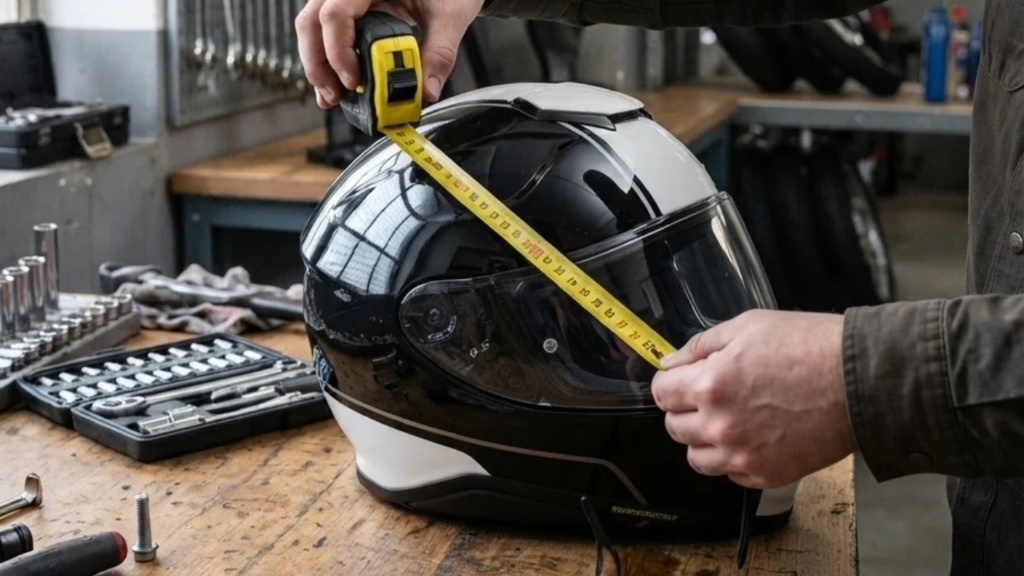
You need a flexible tape measure, the kind used for sewing. If you don’t have one, use a piece of string and measure it against a ruler afterwards.
- Place the tape about 2 cm above your eyebrows, at the front of your head.
- Run it just above your ears, around the widest part at the back of your head.
- Keep the tape level and pull it snug, but not tight.
- Measure three times and use the largest number, in centimetres.
Ask someone to help if you can: it is much easier to keep the tape level when someone else holds it. Write the number down; you will need it for every helmet you look at.
Step 2: Check the Size Chart
Every brand publishes its own size chart, and they don’t all match. As a rough guide, most brands use sizes close to these:
| Size | Typical head circumference |
|---|---|
| XS | 53–54 cm |
| S | 55–56 cm |
| M | 57–58 cm |
| L | 59–60 cm |
| XL | 61–62 cm |
| XXL | 63–64 cm |
This table is only a starting point. Always check the chart of the exact brand and model you want to buy, because a medium from one brand can fit like a small from another. Also look at how many shell sizes a helmet comes in. A model with several shell sizes uses a smaller outer shell for smaller heads, which keeps the helmet compact and light. A model with one shell size makes the small sizes fit by adding thicker padding, so the helmet looks and feels bigger.
Step 3: Know Your Head Shape
Two riders with the same head circumference can need completely different helmets, because heads come in different shapes. Look at your head from above (a photo taken from above works well), and you will usually see one of three shapes:
| Head shape | What it looks like from above | What you notice in the wrong helmet |
|---|---|---|
| Long oval | Clearly longer front to back than side to side | Pressure on forehead and back of the head |
| Intermediate oval | Slightly longer than wide; the most common shape | Most helmets fit reasonably well |
| Round oval | Almost as wide as it is long | Pressure on the sides, at the temples |
Most helmets on the market are made for an intermediate oval head. If you have a long or round head, look for brands and models that state their head shape, and try more than one. Pressure on the sides that never goes away usually means the wrong shape, not the wrong size.
Step 4: The Fit Test
Once you have a helmet in the right size, these tests tell you whether it actually fits. Do them with the chin strap fastened.
- Putting it on. A good helmet takes a bit of effort to put on. Pull the straps apart and slide it over your head. If it slips on easily, it is probably too big.
- The cheek pads. Your cheeks should be pushed up slightly, like a gentle squeeze. You should not be able to slide a finger easily between your cheek and the pad.
- The forehead. The top edge of the eyeport should sit just above your eyebrows. You should be able to see straight ahead and to the sides without the helmet blocking your view.
- The shake test. Hold the helmet with both hands and try to turn it left and right, then up and down. Your skin should move with the helmet. If the helmet turns but your head stays still, it is too big.
- The roll-off test. With the strap fastened, push the back of the helmet upwards and forwards. It must not roll off over your forehead. If it does, it is too big or the wrong shape.
- The 20-minute test. Keep the helmet on for at least 20 minutes, in the shop or at home. Small pressure points that turn into a headache will show up. A firm, even squeeze is fine; one sharp pressure point is not.
Keep in mind that the comfort liner settles a little over the first rides. A helmet that feels snug but comfortable on day one will feel just right later. A helmet that feels “comfortable straight away” in the shop often becomes too loose after a few weeks.
Between Two Sizes?
If you fall between two sizes, try both and do the fit test with each. In general, choose the smaller size if it passes the 20-minute test without real pressure points, because the liner will settle. Choose the larger size only if the smaller one causes a pressure point that doesn’t go away. Many helmets also offer thinner or thicker cheek pads, which let you fine-tune the fit without changing size.
Buying a Helmet Online
Buying online is fine, as long as you are careful:
- Try it on in a shop first if you can, especially for an expensive helmet or a brand you haven’t worn before.
- Check the return policy before you order, and keep all labels and the packaging.
- Do the fit test indoors. Don’t ride with it until you are sure: a helmet that has been ridden in usually can’t be returned.
- Check the certification. In Europe, new helmets should carry the ECE 22.06 label.
- Read reviews about sizing. Our helmet reviews always mention whether a model runs small or large. See for example the HJC C10, the AGV K1 S and the Alpinestars S-R7, or the Fox V3 for off-road.
Still choosing a helmet? Our guide to the best motorcycle helmets covers safety ratings, shell types and the best models for every budget.
Common Mistakes
- Choosing the size that feels comfortable in the shop. That helmet is often too big once the liner settles.
- Only looking at size, not shape. The wrong shape gives pressure points that no size can fix.
- Assuming your size is the same in every brand. Always check the size chart.
- Buying a helmet as a surprise gift. Fit is personal. A voucher is a better idea, as we explain in our gift guide for riders.
- Forgetting your glasses. If you ride with glasses, take them along when you try helmets on. Some helmets have channels for the arms; others press them into your temples.
When to Replace Your Helmet
Replace your helmet straight away after a crash or a hard drop, even if you can’t see any damage: the foam liner may be compressed and won’t protect the same way again. Also replace it when it has become loose because the liner has worn down, when the strap or buckle is damaged, or when it no longer meets current standards. Many manufacturers recommend replacing a helmet after about five years of use, because the materials slowly age.
FAQ
How tight should a motorcycle helmet be?
Snug all around, with your cheeks gently pushed up by the cheek pads, but without sharp pressure points. When you turn the helmet with your hands, your skin should move with it. If the helmet turns on its own, it is too loose.
How do I measure my head for a motorcycle helmet?
Use a flexible tape measure about 2 cm above your eyebrows, run it just above your ears and around the widest part of the back of your head. Keep it level, measure three times and use the largest number in centimetres.
Do motorcycle helmets loosen over time?
Yes. The comfort liner and cheek pads settle during the first rides, so a new helmet should feel snug. A helmet that feels loose when new will feel even looser later.
Should I size up or down if I’m between helmet sizes?
In most cases, size down, as long as the smaller helmet passes a 20-minute test without real pressure points. If one spot keeps hurting, try the larger size or a different helmet shape.
Are helmet sizes the same for every brand?
No. Each brand uses its own size chart and head shape. Always check the size chart of the exact model and, if possible, try it on before you buy.
As an Amazon Associate I earn from qualifying purchases. Gear4Moto also earns a commission through other affiliate partners, such as Alpinestars. When you buy through our links, we may earn a small commission at no extra cost to you. We only recommend gear we consider genuinely worth buying.